
Precision Post Hole Concrete Calculator for Footings
Calculate exact cylindrical footing volume, post displacement cutouts, commercial 40-lb, 60-lb, and 80-lb pre-mixed ready-mix bag counts, and regional frost depth allowances instantly.
📊 Concrete Takeoff
Using a mathematically verified Post Hole Concrete Calculator before ordering materials or firing up an auger is the single best way to ensure unyielding fence posts and prevent project delays. In residential construction, fence and deck footings fail primarily because the holes were augered too shallow, sized too narrow, or filled with an arbitrary guess of pre-mixed ready-mix bags. Our responsive Post Hole Concrete Calculator computes the exact right-circular cylindrical volume of your borehole, automatically deducts the internal displacement of embedded 4×4 or 6×6 timber posts, factors in a real-world soil irregularity overage, and tells you exactly how many commercial 80-lb, 60-lb, or 50-lb pre-mixed bags to order.
How to Dig and Pour Concrete Fence Footings (Step-by-Step)
Pouring sturdy, frost-resistant footings requires methodically preparing the subterranean collar before the first batch of concrete is mixed. Here is the field-proven workflow licensed fencing and deck contractors follow:
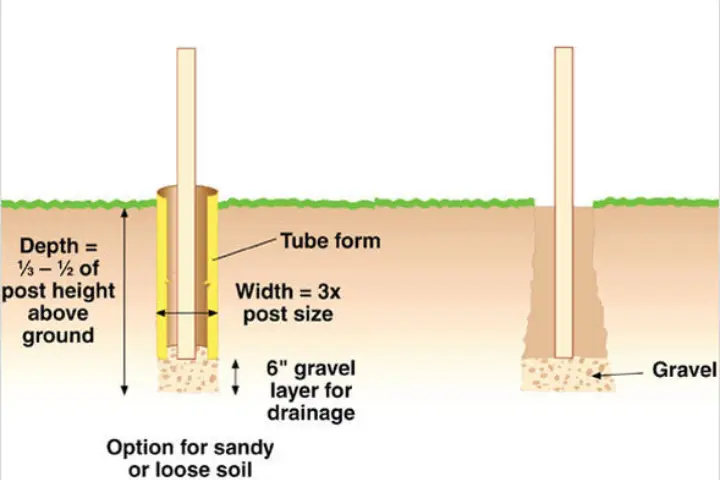
- Apply the “3x Post Width” Rule of Thumb: For standard residential structural posts, always bore a hole whose diameter is roughly three times the thickness of the embedded timber. For a standard 4×4 post (measuring 3.5 inches square), auger a 10-inch to 12-inch diameter hole. For a heavy 6×6 post (5.5 inches actual), excavate a minimum 12-inch to 14-inch diameter borehole.
- Verify Regional Winter Frost Depths: Under residential structural provisions enforced by the International Code Council (ICC), footings must extend at least 6 inches below your local municipality’s established winter frost penetration line. In southern US zones, a depth of 24 to 30 inches suffices; in northern and Midwestern climates, winter frost lines frequently require digging 36 to 48 inches deep to avoid catastrophic seasonal frost heaving.
- Place a 4-to-6-Inch Crushed Gravel Drainage Bed: Never set the bottom end of an unsealed wooden post directly onto damp native clay soil. Shovel 4 inches of crushed angular gravel or washed drainage stone into the base of the hole and tamp it flat. This creates a dedicated subterranean drainage bed that prevents trapped groundwater from rotting the post bottom.
- Plumb and Temporarily Brace the Post: Center your pressure-treated or cedar post in the hole on top of the gravel bed. Use a dual-axis post level to verify vertical plumb on two perpendicular faces. Secure two temporary diagonal 1×4 timber braces staked into the turf to keep the post perfectly vertical while the wet concrete cures.
- Mix and Consolidate Ready-Mix Concrete: Follow commercial ASTM C387 guidelines: combine roughly 3 to 3.5 quarts of clean water per 80-lb bag to achieve a firm oatmeal consistency. Consolidate wet concrete around the post collar using a scrap 2×4 stick or rebar rod to eliminate trapped air pockets and honeycombing.
- Crown the Top Surface for Positive Drainage: Trowel the top concrete collar 1 inch above finished lawn grade, sloping outward away from the post face like a pitched roof. This crown sheds pooling rain runoff and prevents standing water from settling around the vulnerable wood-to-concrete interface.
The Mathematical Formula Behind Cylindrical Post Footings
Online calculators that simply compute length times width times depth generate inaccurate estimates because augered post holes are geometric right cylinders, not square boxes. Furthermore, ignoring the space occupied by the buried timber post leads to over-purchasing concrete bags by 15% to 20%.
Our Post Hole Concrete Calculator uses a two-tier volumetric deduction algorithm:
Once net cubic inches are calculated, the engine converts total volume into commercial cubic feet ($1\text{ cu ft} = 1,728\text{ cu in}$) and determines exact commercial bag yields based on certified wet density ratings ($133\text{ lbs/cu ft}$):
- 80-lb Commercial Bag: Yields approximately $0.60\text{ cubic feet}$ of mixed wet concrete.
- 60-lb Pre-Mixed Bag: Yields approximately $0.45\text{ cubic feet}$ of mixed wet concrete.
- 50-lb Fast-Setting Bag: Yields approximately $0.375\text{ cubic feet}$ of mixed wet concrete.
Real-World Scenarios: 10-Hole Backyard Fence vs. a Heavy Gate Pier
Scenario A: 10 Standard Fence Post Holes (10″ Diameter x 36″ Deep with 4×4 Posts)
Let’s examine a common suburban backyard project: digging 10 post holes along a 6-foot privacy fence run using 4×4 treated pine posts ($3.5” \times 3.5”$ actual face) with a 10% spill buffer:
- Gross cylinder volume per hole: $\pi \times (5\text{ in})^2 \times 36\text{ in} = 3.1416 \times 25 \times 36 = 2,827.4\text{ cu in}$.
- Deduct 4×4 post volume: $3.5\text{ in} \times 3.5\text{ in} \times 36\text{ in} = 441.0\text{ cu in}$.
- Net concrete per hole: $2,827.4 – 441.0 = 2,386.4\text{ cu in} \div 1,728 = 1.381\text{ cu ft}$.
- Multiply across 10 holes with 10% spill: $1.381 \times 10 \times 1.10 = 15.19\text{ total cu ft}$.
- Bag requirements: $15.19 \div 0.60 \approx 25.3 \longrightarrow 26\text{ bags (80-lb)}$ or $34\text{ bags (60-lb)}$. Ordering 26 eighty-pound bags ensures complete coverage without shortfalls.
Scenario B: Heavy 12″ Diameter x 42″ Deep Corner Post (6×6 Post)
Corner, terminal, and gate posts bear significant lateral tension and dynamic swinging weight, requiring larger 12-inch boreholes excavated 42 inches deep with 6×6 posts ($5.5” \times 5.5”$ actual):
- Gross cylinder volume: $\pi \times (6\text{ in})^2 \times 42\text{ in} = 3.1416 \times 36 \times 42 = 4,750.1\text{ cu in}$.
- Deduct 6×6 post volume: $5.5\text{ in} \times 5.5\text{ in} \times 42\text{ in} = 1,270.5\text{ cu in}$.
- Net concrete volume: $4,750.1 – 1,270.5 = 3,479.6\text{ cu in} \div 1,728 = 2.014\text{ cu ft}$.
- Bags needed per single gate post (+10% buffer): $2.014 \times 1.10 = 2.215\text{ cu ft} \div 0.60 \approx 3.7 \longrightarrow 4\text{ bags of 80-lb concrete}$.
Quick Reference: Post Hole Diameter, Depth & Concrete Bag Chart
| Hole Dimensions | Post Size | Net Volume / Hole | 80-lb Bags / Hole | 60-lb Bags / Hole | Bags for 10 Holes (80-lb) |
|---|---|---|---|---|---|
| 8″ Dia. x 24″ Deep | 4×4 Post | 0.53 Cu. Ft. | ~1.0 Bag | ~1.3 Bags | 10 Bags |
| 10″ Dia. x 30″ Deep | 4×4 Post | 1.15 Cu. Ft. | ~2.0 Bags | ~2.8 Bags | 22 Bags |
| 10″ Dia. x 36″ Deep | 4×4 Post | 1.38 Cu. Ft. | ~2.5 Bags | ~3.4 Bags | 27 Bags |
| 12″ Dia. x 36″ Deep | 4×4 Post | 2.10 Cu. Ft. | ~3.8 Bags | ~5.1 Bags | 42 Bags |
| 12″ Dia. x 42″ Deep | 6×6 Post | 2.01 Cu. Ft. | ~3.7 Bags | ~4.9 Bags | 41 Bags |
| 12″ Dia. x 48″ Deep | 6×6 Post | 2.30 Cu. Ft. | ~4.2 Bags | ~5.6 Bags | 46 Bags |
The 5 Most Costly Concrete Footing Mistakes DIYers Make
Setting posts in concrete seems simple, but these five field errors frequently lead to rotted posts, frost heaves, and crooked fence lines:
- Enclosing the Bottom of the Post in Concrete: Pouring concrete completely under and around the bottom timber creates a sealed “concrete boot.” When rainwater runs down the post shaft, it gets trapped in this cup with nowhere to drain, accelerating severe bottom rot within 3 to 4 years. Always rest the post bottom on porous crushed gravel.
- Digging Shallow Footings Above the Frost Line: If you dig a 24-inch hole in a region where the winter frost depth reaches 36 inches, subterranean ground freezing will literally push the entire concrete collar upward out of the soil (frost heave). Always dig at least 6 inches below your local municipality’s frost line.
- Adding Too Much Mixing Water: A wet, soupy concrete mix is easy to pour, but excessive water severely weakens cured compressive strength. Concrete mixed with too much water develops extensive shrinkage cracks, reducing its PSI load-bearing capacity by more than 40%.
- Digging Cone-Shaped (Funnel) Holes: When hand diggers hit tough soil, they often create a wide opening at the surface that tapers to a narrow point at the bottom. This cone shape acts as an inverted wedge: winter freeze-thaw cycles grip the wide concrete collar and push the post straight up. Always maintain straight, parallel cylindrical sidewalls.
- Omitting a 10% Soil Irregularity Buffer: Standard calculations assume smooth, perfect steel cylinders. In real dirt, tree roots, clay pockets, and auger chatter create rough cavities that absorb extra concrete. Always add a 10% material buffer to avoid mid-pour hardware store runs.
Frequently Asked Questions About Post Hole Concrete Calculator
How many 80-lb bags of concrete do I need for a 4×4 fence post?
For a standard residential fence with a 10-inch diameter hole dug 36 inches deep, you need approximately 2.5 to 3 eighty-pound bags of concrete per post hole (or roughly 3.5 to 4 sixty-pound bags). For a lighter 30-inch deep hole, 2 eighty-pound bags per hole is generally sufficient.
What is the rule of thumb for post hole diameter?
The accepted construction standard is that the diameter of your post hole should be three times the nominal width of the post. For a standard 4×4 post (3.5″ actual), dig a 10-inch to 12-inch diameter hole. For a heavy 6×6 post (5.5″ actual), dig a 12-inch to 14-inch diameter hole.
Is dry-pour concrete acceptable for structural fence posts?
While fast-setting dry-pour mixes work for lightweight, non-load-bearing garden fences by soaking in ground moisture, pre-mixing with measured water in a wheelbarrow provides significantly higher compressive strength and prevents dry, unhydrated pockets inside structural footings.
How much wet concrete volume does one 80-lb or 60-lb bag yield?
One standard 80-lb bag of pre-mixed concrete yields approximately 0.60 cubic feet of mixed wet concrete. A 60-lb bag yields approximately 0.45 cubic feet, and a 50-lb fast-setting bag yields approximately 0.375 cubic feet. It takes 45 eighty-pound bags to equal one full cubic yard.
Why does the Post Hole Concrete Calculator deduct post volume?
The embedded wooden post physically displaces volume inside the hole. For a 4×4 post set 36 inches deep, the wood takes up roughly 441 cubic inches (about 0.25 cubic feet). Deducting this displacement prevents you from over-purchasing extra concrete bags you won’t use.
Explore Complementary Construction Calculators
Building exterior residential projects? Use our other mathematically verified estimation utilities:
Summary: Solid Footings Guarantee an Unyielding Structure
Taking two minutes to verify your required concrete bag count with our Post Hole Concrete Calculator protects your project from mid-pour shortfalls, messy overages, and expensive structural failures. Excavate below regional frost depths, place 4 inches of drainage gravel, deduct timber post displacement, and crown the top surface to ensure straight, unyielding posts for decades to come.