
Precision Paver Base Calculator
Estimate the crushed stone base required for patios, walkways and driveways. Calculate base footprint, loose aggregate volume and estimated delivery tonnage.
📊 Your Estimate
The 6-inch extension is an optional estimating assumption applied to each side. Adjust the project dimensions if your design requires a different excavation footprint.
A reliable Paver Base Calculator helps estimate the crushed aggregate needed beneath a patio, walkway or driveway. Ordering too little stone can delay a project, while ordering too much increases delivery and handling costs. This calculator uses the finished dimensions, selected compacted base depth, an optional perimeter extension, a volume-reduction allowance and an estimated aggregate density to produce a useful starting quantity.
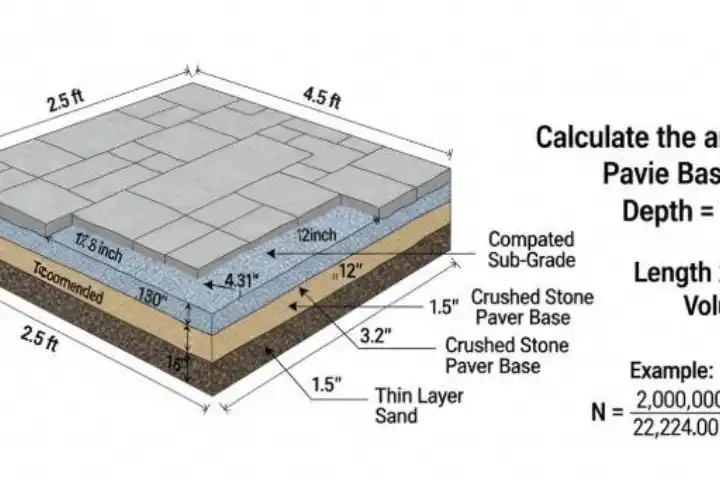
How to Use the Paver Base Calculator
- Enter the finished project length and width in feet.
- Select the planned compacted aggregate depth, or choose a custom depth.
- Enter an expected volume-reduction percentage based on the material and supplier’s guidance.
- Adjust the estimated tons per cubic yard if your supplier provides a different bulk density.
- Press Calculate Aggregate Requirements and review the estimated quantities before ordering.
How the Calculation Works
The calculator first estimates the finished surface area. It then adds a 6-inch extension to every side of the project as an initial excavation allowance. This extension is an assumption, not a universal requirement; follow the project design and applicable installation guidance.
1. Finished surface area
Area = Length × Width
2. Extended base footprint
Extended Area = (Length + 1 ft) × (Width + 1 ft)
3. Compacted base volume
Volume (yd³) = Extended Area × Depth (in) ÷ 12 ÷ 27
4. Loose order volume
Loose Volume = Compacted Volume ÷ (1 − Reduction % ÷ 100)
5. Estimated delivery weight
Weight (short tons) = Loose Volume × Density (tons/yd³)
Example: A 20 × 15 Foot Patio
Suppose a patio measures 20 feet by 15 feet, requires a 4-inch compacted base, uses a 15% volume-reduction allowance and has an assumed aggregate density of 1.35 short tons per cubic yard.
- Finished area: 20 × 15 = 300 sq ft.
- Extended footprint: 21 × 16 = 336 sq ft.
- Compacted volume: 336 × 4 ÷ 12 ÷ 27 = approximately 4.15 yd³.
- Loose order volume: 4.15 ÷ 0.85 = approximately 4.88 yd³.
- Estimated weight: 4.88 × 1.35 = approximately 6.59 short tons.
These figures are estimates, not a guarantee of the exact quantity delivered or installed. Confirm the compaction allowance and material density with your quarry or contractor.
Choosing a Suitable Base Depth
Required depth depends on soil conditions, drainage, expected loads, local climate and the paving system. The options below are general estimating examples, not engineering specifications.
| Project Type | Example Depth | What to Consider |
|---|---|---|
| Garden path | 3 inches | Soil stability and pedestrian use |
| Patio or walkway | 4 inches | Drainage, soil and paving-system guidance |
| Heavier-use patio | 6 inches | Subgrade strength and expected loads |
| Residential driveway | 8 inches or as designed | Vehicle loads, climate and local specifications |
Tips for Preparing a Paver Base
- Prepare the subgrade: Remove organic soil and unsuitable material, and address soft spots before placing aggregate.
- Manage drainage: Plan the finished slope and water runoff to help prevent pooling and erosion.
- Use suitable aggregate: Select a compactable base material appropriate for the paving system and local conditions.
- Compact in suitable lifts: Follow the aggregate supplier’s and equipment manufacturer’s recommendations for layer thickness and moisture.
- Check the bedding layer: Use the bedding material and thickness specified for your chosen paver system.
- Allow for waste: Irregular edges, handling losses and site conditions can change the quantity required.
Frequently Asked Questions
How deep should a paver base be?
Depth depends on the project, soil, climate and expected loads. Four inches is a common estimating starting point for some pedestrian patios, but it is not appropriate for every site. Follow the paving-system specifications and local guidance.
How much does one cubic yard of crushed stone weigh?
Weight varies with aggregate type, grading and moisture. This calculator starts with 1.35 short tons per cubic yard as an editable estimate. Use the supplier’s stated bulk density for a more reliable order.
Why is a compaction allowance included?
Loose aggregate changes volume as it is placed and compacted. The required allowance depends on the material and site conditions. This calculator treats the entered percentage as the fraction of loose volume lost during compaction.
Does the calculator include bedding sand and pavers?
No. The estimate covers the aggregate base only. Bedding material, pavers, jointing material, geotextile, excavation spoil and delivery minimums must be estimated separately.
Is the 6-inch perimeter extension always required?
No. It is a configurable planning assumption in this calculator, not a universal code requirement. Use the extension specified by the paving system, edge restraint design and site plan.
Explore More Construction Calculators
Use these related tools to estimate quantities for other outdoor projects.
Final Checklist Before Ordering
Measure the project carefully, confirm the required compacted depth, check the aggregate’s estimated density and ask your supplier about compaction and delivery quantities. For vehicle-bearing or otherwise engineered installations, follow the applicable project specifications rather than relying on a calculator alone.