
Precision Fence Picket Calculator for Lumber Takeoffs
Calculate exact vertical wooden pickets, shadowbox overlap patterns, board-to-board air gaps, and commercial scrap buffers across any linear fence perimeter.
📊 Lumber Takeoff
Using a dependable Fence Picket Calculator before placing a lumber yard order is the best insurance against halted construction and mismatched wood dye-lots. When building a residential privacy fence, running twenty pickets short on a Saturday afternoon leaves your yard exposed and forces an emergency run for warped, picked-over retail lumber. Conversely, guessing without accounting for nominal board planing leaves expensive stacks of cedar slats rotting on your lawn. Our responsive Fence Picket Calculator translates nominal timber labels into true milled dimensions, computes complex board-on-board shadowbox overlaps, and factors in a safety scrap buffer so your fence line finishes clean on budget.
How to Measure and Install Vertical Fence Pickets (Step-by-Step)
Hanging fence pickets straight, plumb, and uniform requires methodical prep work across your horizontal framework. Here is the step-by-step field process professional fencing crews use:
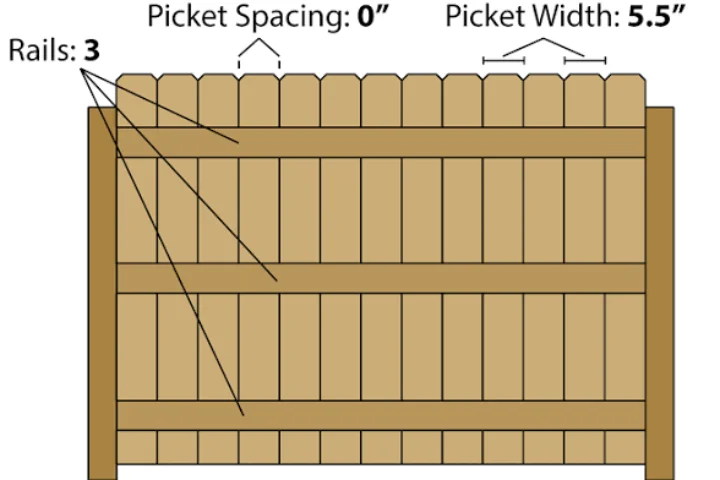
- Complete Structural Post & Rail Framework: Ensure all vertical posts are anchored in cured concrete and your horizontal 2×4 framing rails (stringers) are fastened dead-level. A 6-foot fence requires 3 horizontal rails (top, middle, and bottom) to prevent boards from cupping.
- Measure the True Linear Footage: Pull a 100-foot fiberglass measuring tape along the outside face of your framing rails from corner post to corner post. Account for each fence run independently rather than guessing total yard acreage.
- Set a Plumb Starting Slat: Attach your very first picket at a terminal corner post using a 4-foot carpenter’s spirit level. Fasten it securely with exterior ring-shank nails. Never trust a corner post to be plumb without verifying it yourself.
- Elevate 2 Inches Above Ground: Rest the bottom edge of your pickets on a temporary 2×4 scrap spacer board laid flat on the ground. Keeping pickets 2 inches above the soil line prevents capillary moisture wicking that causes premature bottom-rot.
- Use a Sizing Spacer Block: If installing spaced pickets, cut a timber spacer block exactly matching your desired air gap. Hold the block firmly against the previous board and press the new picket against it to maintain uniform rhythm without tape measuring every slat.
- Fasten with 2 Nails per Rail: Drive hot-dipped galvanized or 304 stainless steel ring-shank nails at every rail junction (6 fasteners per picket on a 3-rail fence). Smooth electro-galvanized nails back out over winter freeze-thaw cycles.
The Mathematical Formula Behind Slat Coverage & Waste Buffers
The number one mistake DIY builders make is calculating board quantities using nominal lumber names ($1\times6$ or $1\times4$). In modern commercial milling, a nominal $1\times6$ board is planed smooth down to $5\frac{1}{2}\text{ inches}$ ($5.5\text{ inches}$ actual width). If you have a $100\text{-foot}$ run ($1,200\text{ inches}$) and divide by $6\text{ inches}$, you calculate $200\text{ pickets}$. In reality:
Our Fence Picket Calculator determines the net boards required by calculating the **Effective Board Pitch** based on your chosen installation style:
Real-World Field Scenarios: A Solid 100-Foot Fence vs. a Shadowbox Run
Scenario A: 100-Foot Backyard Privacy Fence (Solid Butt Joints)
Let’s examine a common suburban backyard project: a $100\text{-foot}$ continuous rear property boundary built with standard $1\times6$ Western Red Cedar pickets ($5.5\text{ inches}$ actual face) installed touching tight with a $10\%$ scrap buffer:
- Perimeter in linear inches: $100\text{ ft} \times 12 = 1,200\text{ inches}$.
- Net structural pickets: $1,200 / 5.5 \approx 218.18 \longrightarrow 219\text{ pickets}$.
- Add 10% lumber scrap allowance: $219 \times 1.10 = 240.9 \longrightarrow 241\text{ boards}$.
- Fasteners needed: $241\text{ pickets} \times 6\text{ nails (3 rails)} \approx 1,446\text{ ring-shank nails}$. Ordering a 5-lb box (approx. 1,500 nails) completes the job without a mid-project hardware store trip.
Scenario B: 100-Foot Board-on-Board Shadowbox Fence (1-Inch Overlap)
Board-on-board fences place alternating slats on opposite sides of the rail with a 1-inch overlap. This creates total privacy even when timber seasons and shrinks:
- Effective horizontal coverage: $5.5\text{ inches} – 1.0\text{ inch overlap} = 4.5\text{ inches effective pitch}$.
- Net structural pickets: $1,200\text{ inches} / 4.5\text{ inches} = 266.67 \longrightarrow 267\text{ pickets}$.
- Factoring in 10% waste buffer: $267 \times 1.10 = 293.7 \longrightarrow 294\text{ boards}$.
- Lumber comparison: Board-on-board requires 53 more boards than a flat fence, but it guarantees zero sightline gaps as the wood seasons in summer heat.
Quick Reference: Fence Picket Sizing & Lumber Coverage Chart
| Nominal Size | Actual Milled Width | Style / Spacing | Pickets per 10 Ft | Pickets per 100 Ft (+10%) |
|---|---|---|---|---|
| 1×4 Picket | 3.50 Inches | Solid Privacy (Tight) | ~35 Pickets | ~378 Pickets |
| 1×4 Picket | 3.50 Inches | Spaced (1.5″ Air Gap) | ~24 Pickets | ~264 Pickets |
| 1×6 Picket | 5.50 Inches | Solid Privacy (Tight) | ~22 Pickets | ~241 Pickets |
| 1×6 Picket | 5.50 Inches | Shadowbox (1″ Overlap) | ~27 Pickets | ~294 Pickets |
| 1×6 Picket | 5.50 Inches | Spaced (2.0″ Air Gap) | ~16 Pickets | ~176 Pickets |
The 5 Most Costly Fence Picket Mistakes Homeowners Make
Working with dimensional timber requires understanding how wood behaves outdoors. Avoid these five common installation traps:
- Dividing Run Footage by the Nominal Board Label: Assuming a $1\times6$ covers 6 inches is the primary reason builders run short. A $1\times6$ covers only $5.5\text{ inches}$. Across a 100-foot run, that half-inch deficit compounds into a 19-board shortage.
- Leaving Large Gaps Between Wet Pressure-Treated Boards: Green treated pine holds significant internal water weight from chemical treatment cylinders. As it dries in hot summer sun, each picket shrinks $1/8\text{ to }1/4\text{ inch}$ in width. If installed with an intentional gap, you end up with see-through sightlines.
- Letting Picket Bottoms Touch Native Lawn: Wood touching damp soil absorbs moisture like a sponge. Rotting begins at ground level within 24 months. Always maintain a minimum 2-inch clearance above mulch or dirt.
- Using Smooth Electro-Galvanized Finish Nails: Smooth nails lack mechanical pull-out resistance. When pickets cup or warp under thermal stress, smooth nails pop loose. Always fasten with ring-shank nails or exterior polymer-coated screws.
- Fastening with Only One Central Nail per Rail: One nail allows wood to cup into a trough shape across its face. Always drive two nails spaced $1\text{ inch}$ inward from each outer edge into every 2×4 rail.
Frequently Asked Questions About Fence Picket Calculator
How many pickets do I need for a 100-foot privacy fence?
For a solid privacy fence with zero air gaps, a 100-foot run requires 219 standard 1×6 pickets (5.5″ actual face) or 343 standard 1×4 pickets (3.5″ actual face). Adding a 10% lumber waste allowance brings your recommended purchase order to 241 or 378 boards respectively.
What is the actual width of a 1×6 and 1×4 fence picket?
In North American lumber manufacturing, rough-sawn wood is planed smooth during surfacing. A nominal 1×6 picket actually measures 5.5 inches wide, and a nominal 1×4 picket actually measures 3.5 inches wide. Thickness is typically 5/8 inch to 3/4 inch.
Why does a board-on-board fence require more pickets?
Board-on-board fences overlap pickets by 1 inch to guarantee 100% privacy even when boards shrink. This overlap reduces each board’s effective horizontal coverage from 5.5 inches to 4.5 inches, requiring approximately 22% more pickets than a flat butt-joint layout.
Why should I add a 10% waste buffer to my lumber order?
Commercial bundles of utility-grade cedar and pine inevitably include boards with split ends, loose knot holes, cupping, or bowing. A 10% buffer ensures you have enough straight, defect-free boards to finish your perimeter without extra lumber yard trips.
Should I use cedar or pressure-treated pine for fence pickets?
Western Red Cedar contains natural tannins that resist rot, insects, and warping with minimal shrinkage. Pressure-treated pine is budget-friendly and durable against soil termites, but experiences noticeable shrinkage as it dries in direct sunlight.
Explore Complementary Construction Calculators
Building or repairing exterior projects? Use our other mathematically verified estimation utilities:
Summary: Accurate Lumber Takeoffs Guarantee a Flawless Fence
Taking two minutes to verify your required timber count with our Fence Picket Calculator protects your project from mid-construction lumber shortages, warped leftovers, and unexpected budget creep. Factor in actual $5.5\text{-inch}$ milled board faces, match your layout style, add a 10% scrap buffer, and your privacy fence will assemble straight, solid, and gap-free.